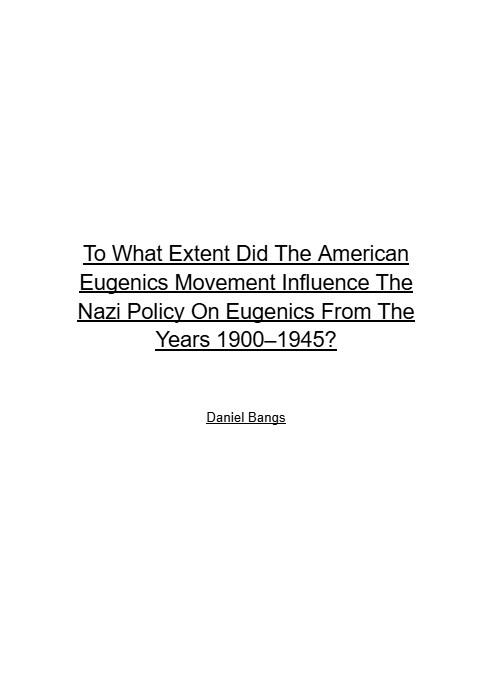
EUGENICS RESEARCH PAPER
American Eugenics and Nazi Eugenic Policy, 1900–1945
Extended Project Qualification (EPQ) · Completed 2026 · Awarded A*
My Extended Project Qualification explored the relationship between the American eugenics movement and the development of Nazi eugenic policy between 1900 and 1945.
The project began with a central question:
To what extent did the American eugenics movement influence Nazi policy on eugenics from the years 1900–1945?
Through the project, I examined the development of eugenics in the United States, its use in sterilisation and immigration policy, the development of German and Nazi eugenics, and the connections between American and German researchers, institutions and legislation. The paper then considers how far American influence can explain Nazi policy and where the two movements diverged.
THE RESEARCH
The paper is divided into three main areas of investigation.
01
The first examines the development of American eugenics, including compulsory sterilisation, immigration restrictions, the Eugenics Record Office, the Human Betterment Foundation and the significance of Buck v. Bell.
02
The second explores the development of eugenics in Germany and under the Nazi regime, from earlier ideas of racial hygiene through sterilisation legislation and the subsequent expansion of Nazi racial and eugenic policy.
03
The final section considers the connections between the American and German movements, examining areas including legislation, academic relationships, research institutions and the exchange of eugenic ideas between the two countries.
CONCLUSION
My research concluded that the American eugenics movement had a significant influence on the development of Nazi eugenics, particularly during its earlier stages.
American sterilisation legislation, research and eugenic institutions provided precedents that German eugenicists could study and adapt. However, the project also argues that American influence alone cannot explain the subsequent development of Nazi policy. Nazi eugenics developed within Germany's own political, ideological and racial context and ultimately became substantially more radical.
The distinction became central to my answer: American eugenics contributed to the foundations and development of Nazi eugenic policy, but did not independently determine the direction or ultimate extent of Nazi persecution and mass murder.
THE PROJECT
This research was completed as my Extended Project Qualification (EPQ) and was awarded an A*.
Completing the project involved developing the research question, reviewing historical and academic material, evaluating different interpretations and sources, organising a large body of research, and producing the final dissertation.
The finished paper includes a glossary, supporting appendices, a chronology of major events, profiles of significant individuals, figures and a full bibliography.
Qualification: Extended Project Qualification (EPQ)
Subject: History / Eugenics
Completed: 2026
Grade: A*
Length: 39 pages
READ THE PAPER
The complete research paper is available below in PDF format.
Content warning: This project examines eugenics, compulsory sterilisation, Nazi persecution and the Holocaust. It includes historical terminology and imagery that some readers may find offensive or distressing. Historical terminology is retained where relevant to the subject and context of the research.
READ / DOWNLOAD THE FULL PAPER (PDF) ↓
(coming soon)
Writing & Research