
Earlier Work
Drawing has been an important part of my creative work, although my relationship with it has not always been straightforward. The work shown here was largely produced during my GCSE Art course between 2021 and 2024, across two projects exploring Natural Structures and Boundaries, Borders & Edges.
I wasn't an especially accomplished artist when I began the course. Most of the technical ability visible here developed relatively late, particularly from the end of Year 10 onwards. Over the following year, I became increasingly obsessive about both the artwork itself and how it was presented. Individual drawings could take tens of hours, while portfolio pages were measured, cut and assembled to millimetre precision.
Research was equally important to the process. For my Natural Structures project, I sourced and photographed specimens myself, including purchasing taxidermy butterflies and visiting butterfly houses in France. For my later project, I visited several museums, including The Tank Museum and Imperial War Museums, to build my own collection of reference photography.
That year transformed my technical ability, particularly in graphite and coloured pencil. It also became an enormous undertaking. By the final months of the course I was routinely sacrificing sleep to complete the portfolio, and the intensity ultimately left me burnt out from drawing for several years.
I began Year 10 predicted a Grade 5 in Art. That rose progressively to a predicted Grade 9 in my final report, and I ultimately achieved a Grade 9 in GCSE Fine Art.
Looking back after several years away from the work, I'm incredibly proud of what I produced — not simply because of the final grade, but because these pieces document how quickly I learned, how much care I was capable of putting into something, and just how far I was willing to push an idea once I became invested in it.
Natural Structures
Natural Structures was the first major body of work I developed during GCSE Art, beginning in 2021 and evolving considerably over the following two years. What started as a broad investigation of organic forms gradually became focused on the extraordinary structures, patterns and colours found in butterflies and insects.
Research became a significant part of the project. Rather than relying solely on existing imagery, I built my own collection of source material: photographing natural forms and preserved specimens, purchasing taxidermy butterflies specifically to study, and photographing live butterflies at butterfly houses, including during trips to France. These references became the basis for increasingly detailed observational drawings and experiments.
The project also documents a period of enormous technical development. I returned to and improved earlier work as my ability progressed, while teaching myself to control coloured pencil through increasingly complex pieces. By the end of the project, individual drawings were taking upwards of 20 hours and could involve dozens of individually layered colours.
More than two years of experimentation eventually culminated in the Kaleidoscope, a large-scale final composition developed from my own source photography and studies, which took more than 100 hours to complete.
Starfish
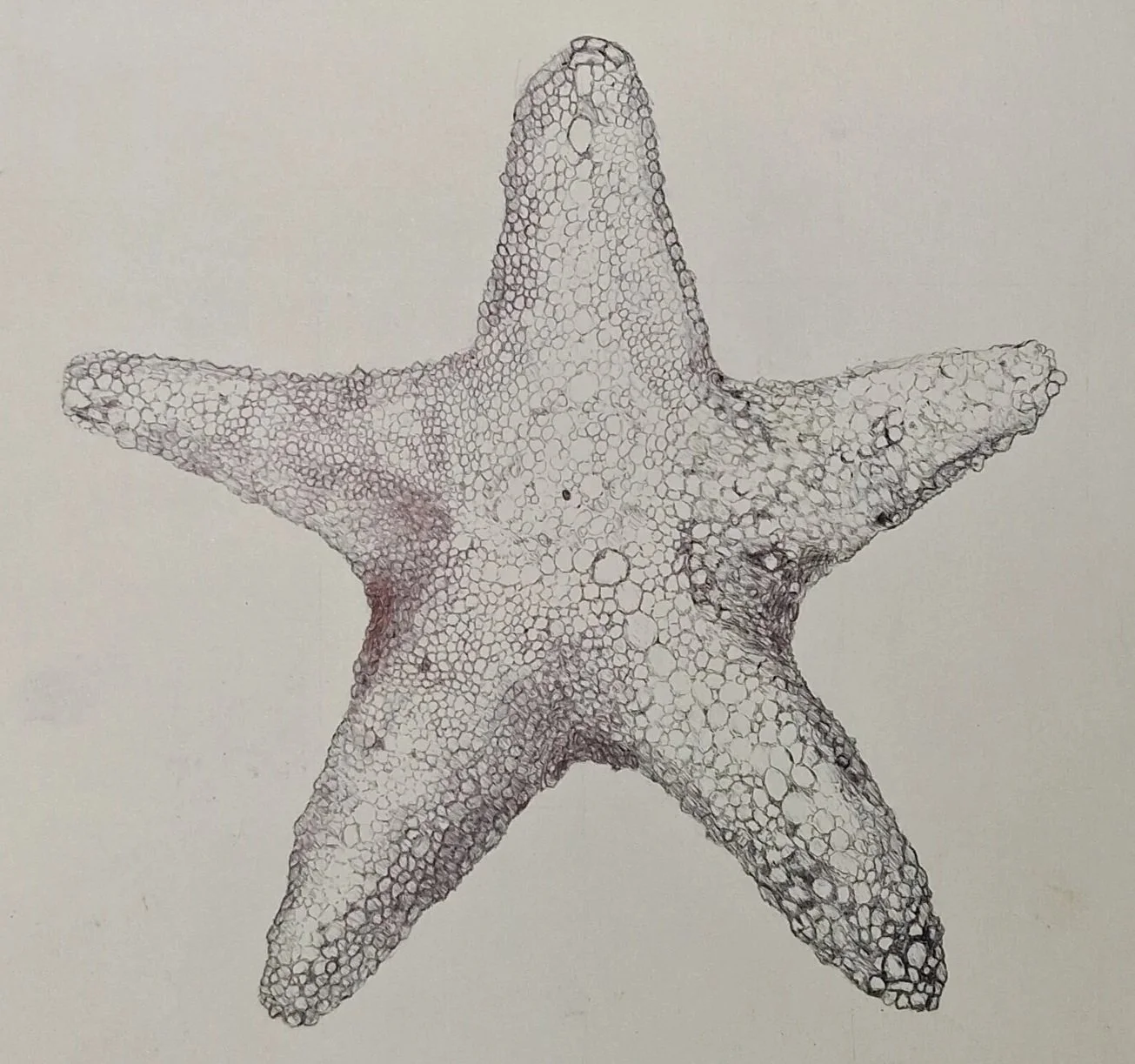
Daniel Bangs · June 2022
Biro On Paper · 15 hours
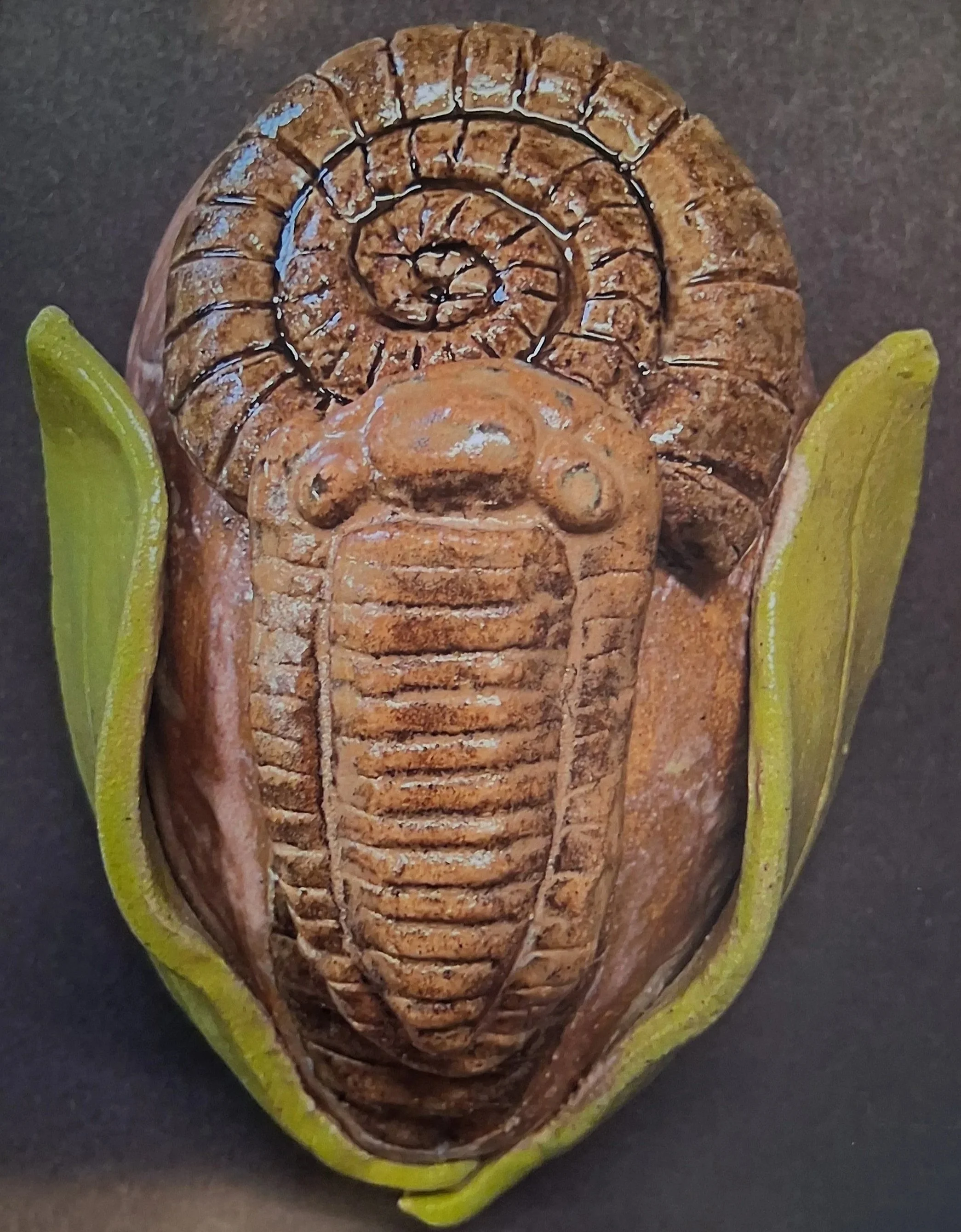
Fossil Form
Daniel Bangs · October 2022
Clay & Glaze · 10 hours
Dog Study — after Henry Moore
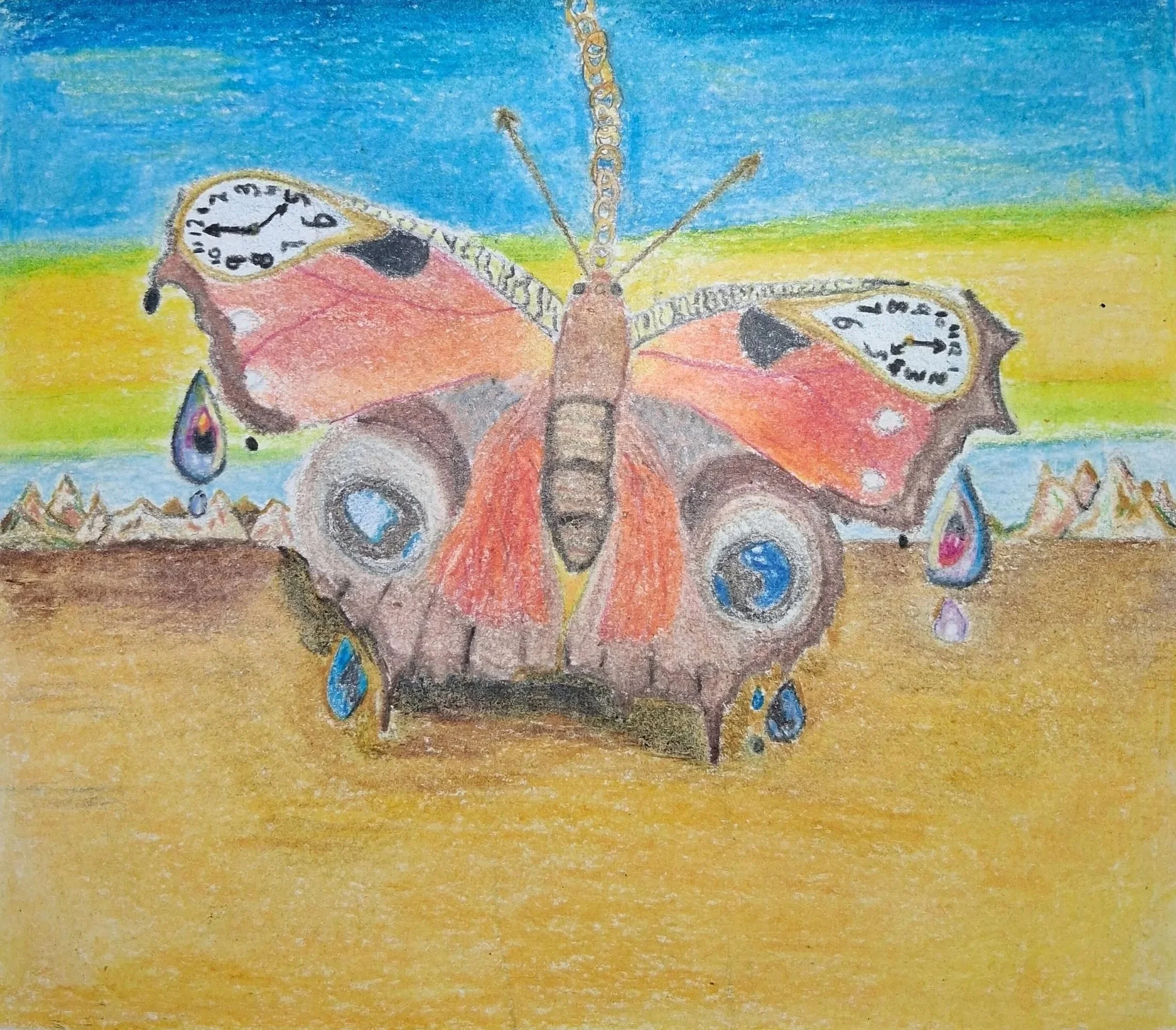
Butterfly Study — after Salvador Dalí
Daniel Bangs · July 2023
Coloured Pencil & Watercolour On Paper · 15 hours
A3
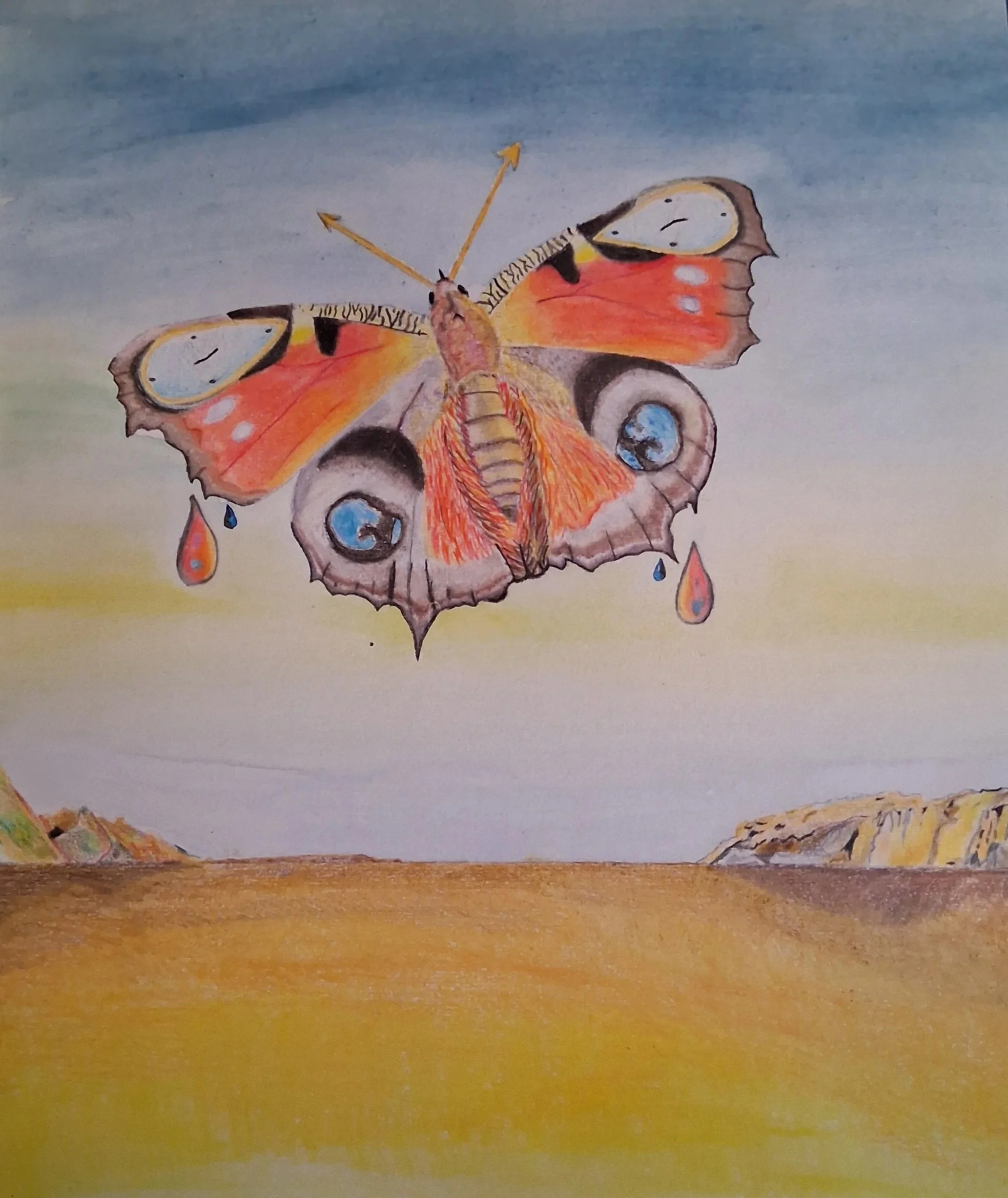
Created as the final piece for my Year 10 mock examination, this A3 composition was completed over 10 hours under timed conditions. It marked the end of the initial, more directed stage of my Natural Structures coursework, before I began developing the project along my own chosen pathway.
Influenced by the work of Salvador Dalí, the piece combines detailed coloured-pencil drawing with a watercolour sky and incorporates butterflies alongside surrealist imagery. It gave me an opportunity to move beyond individual observational studies and experiment with bringing different subjects, techniques and influences together within a single composition.
Because the work was completed under timed examination conditions, the composition also required me to balance detail with the practical limitations of the ten-hour period. I had to plan where to concentrate the most intricate coloured-pencil work while using watercolour to cover the larger area of the sky more efficiently. This combination of media allowed me to create contrast between the precisely rendered foreground elements and the softer background, while ensuring the piece could be completed within the allotted time.
The piece became an important point in the development of the project. After completing it, I was able to take Natural Structures in a more independent direction, eventually developing the butterfly imagery much further through my subsequent studies and final outcome.
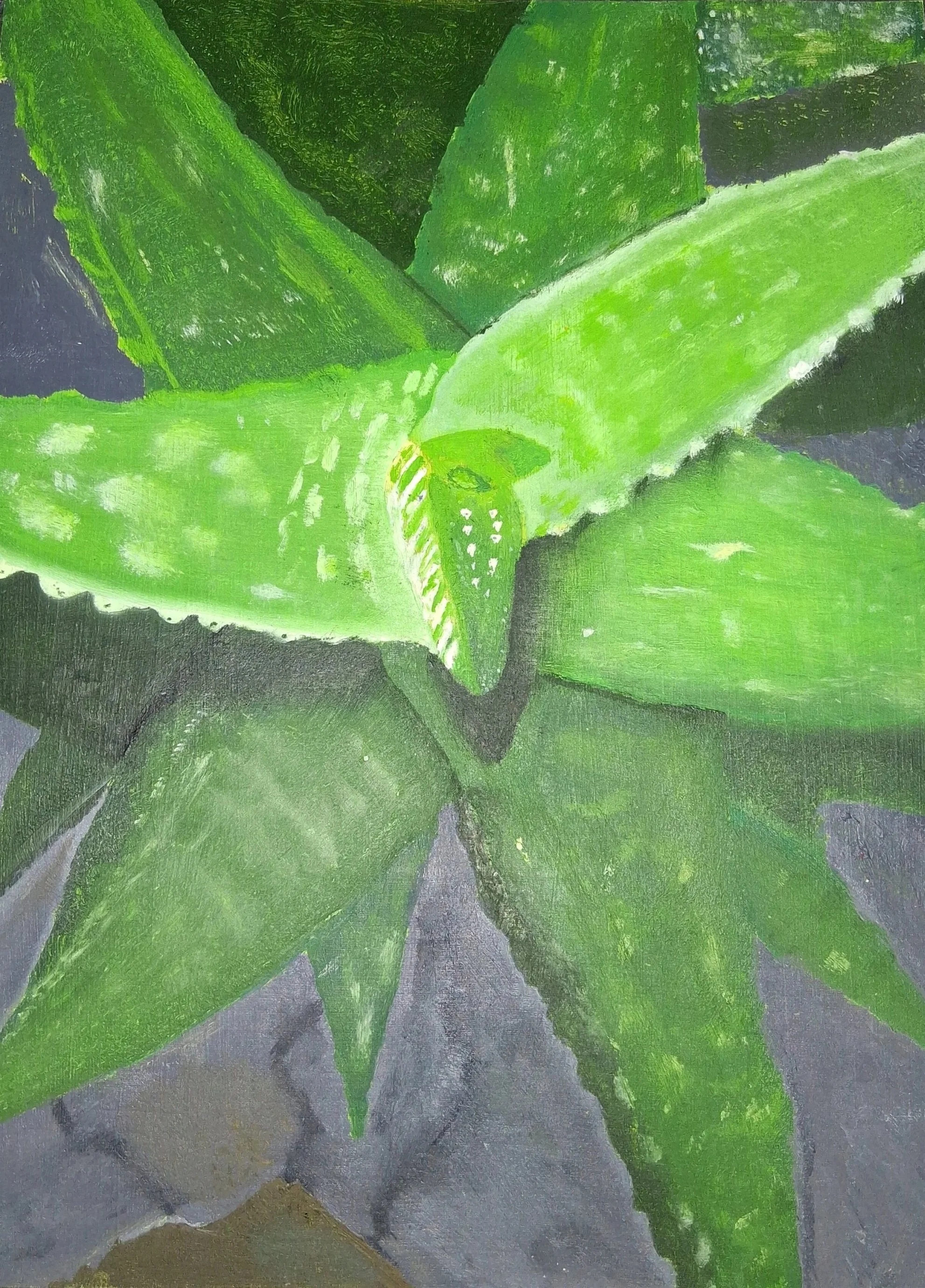
Daniel Bangs · May 2023
Oil Paint On Board · 20 hours
A4
Purple Butterfly
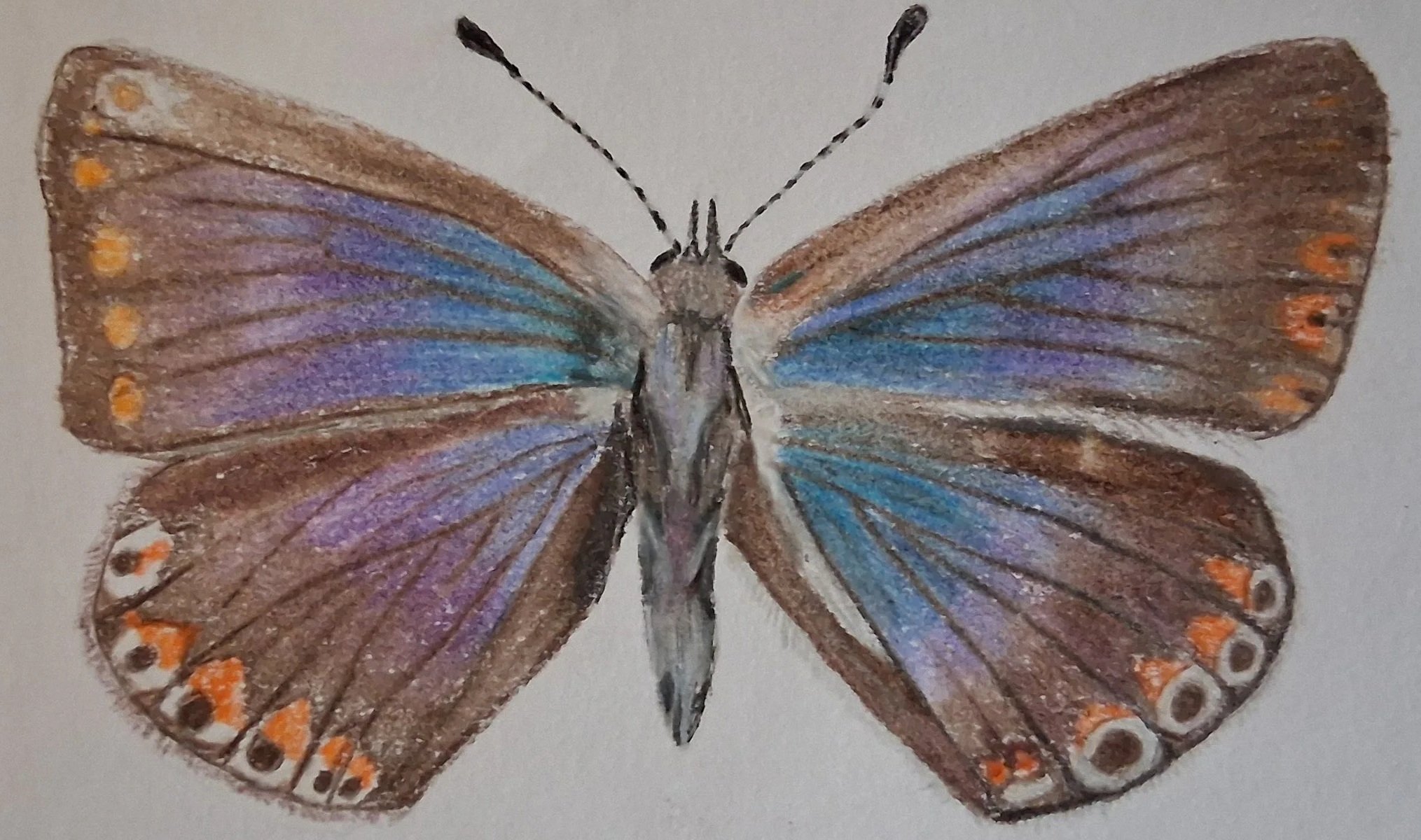
Daniel Bangs · January 2023
Mixed Media - Graphite, Biro & Coloured Pencil On Paper · 20 hours
A4
Dog Study — after Henry Moore
Blue Butterfly
Daniel Bangs · September 2023
Coloured Pencil On Paper · 25+ hours
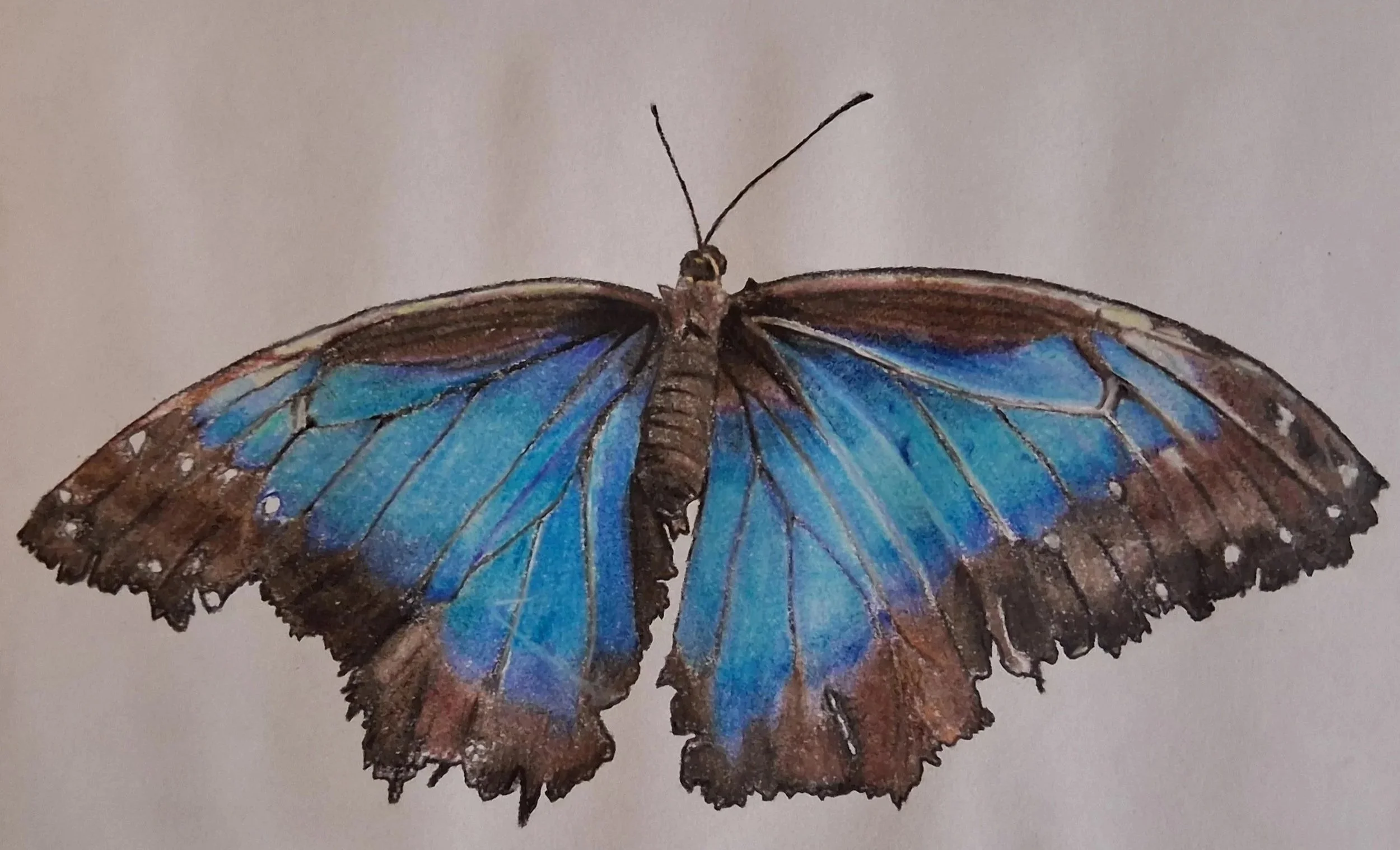
Created as part of my Natural Structures coursework, this observational study of a blue morpho butterfly explored colour, texture and intricate natural form.
The drawing was developed gradually through layers of coloured pencil, building from lighter blues into deeper tones around the edges of the wings. Particular attention was given to the contrast between the vivid blue surfaces and darker markings, alongside the fine veins running throughout each wing. This required careful observation and control over pressure, layering and blending.
This piece reflects the increasing focus on realism and close observation within my work. Butterflies became a recurring subject throughout Natural Structures, and ultimately helped inform the larger compositions developed later in the project, including my final Kaleidoscope Butterflies piece.
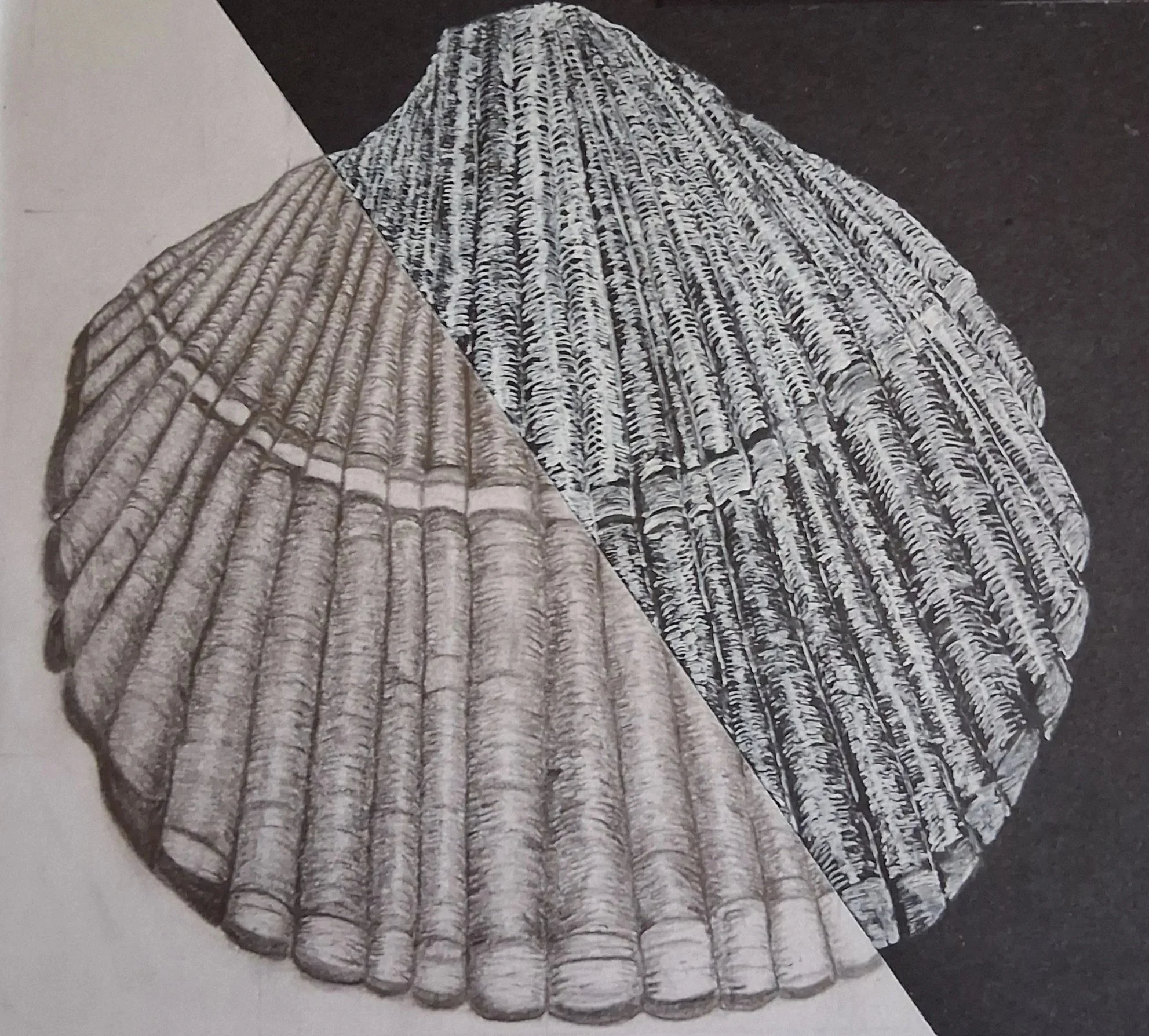
Seashell
Daniel Bangs · January 2024
Graphite On Paper · 12 hours
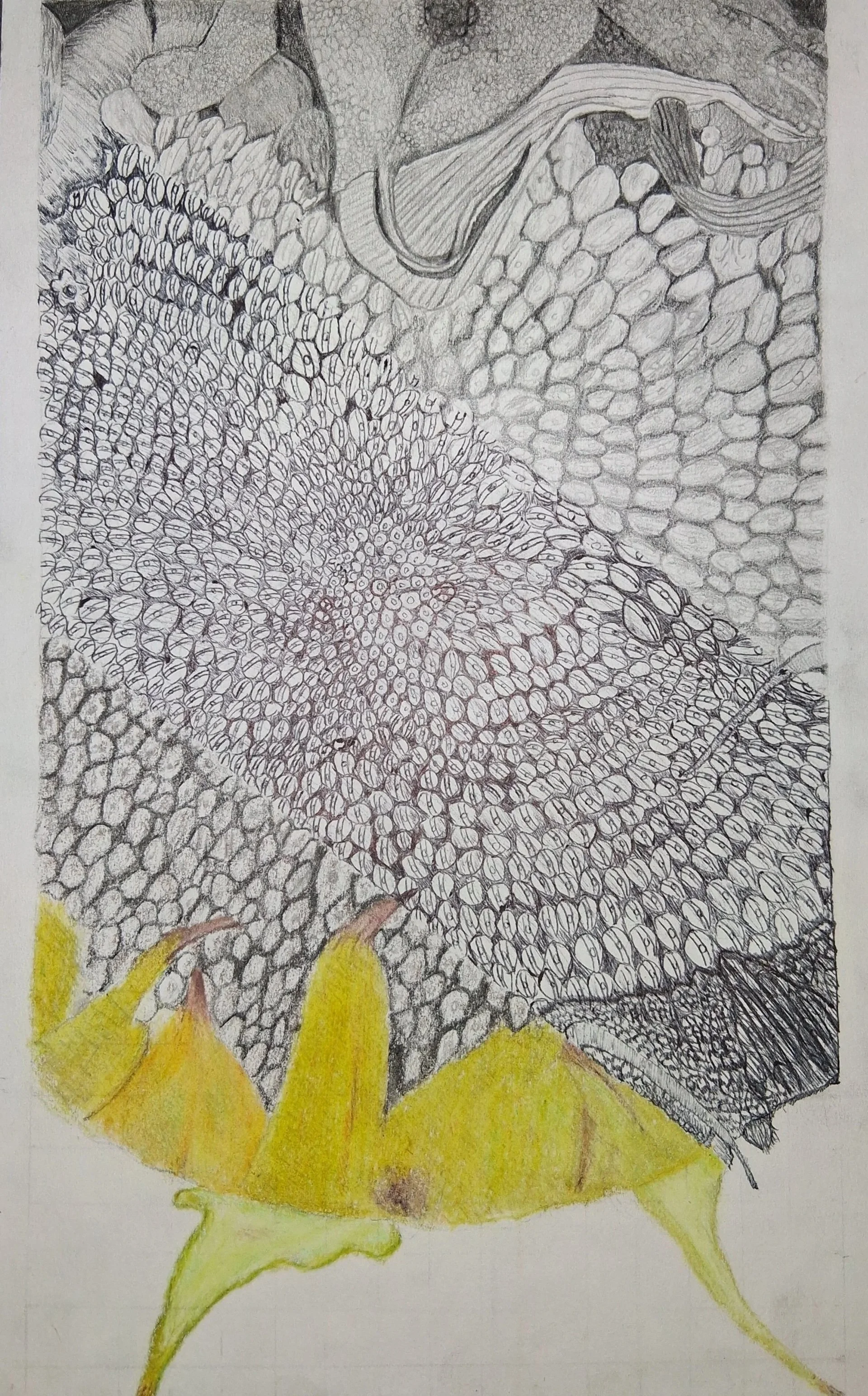
Succulent Plant Study
Daniel Bangs · October 2023
Mixed Media - Graphite & White Gel Pen On Paper · 14 hours
Sunflower
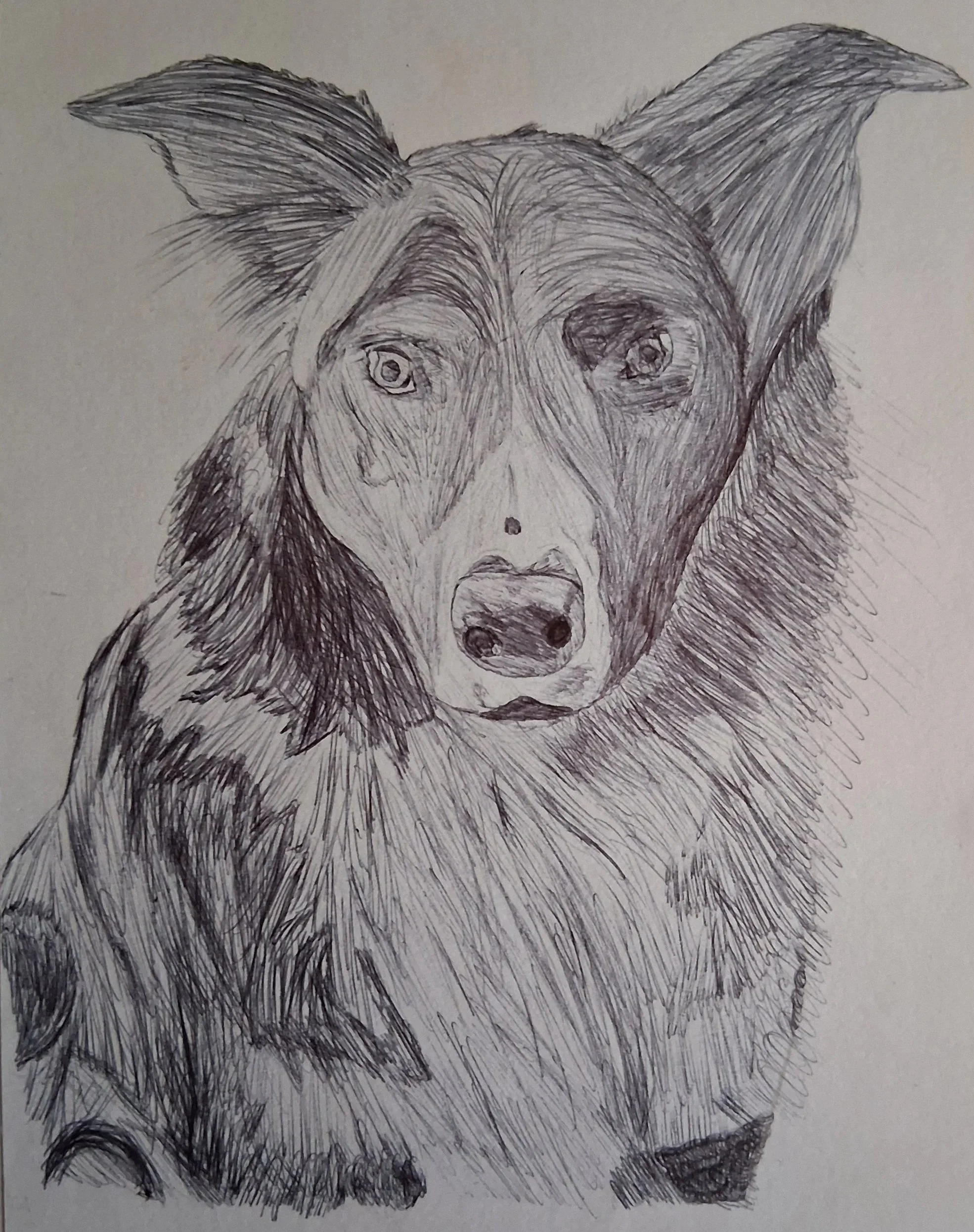
Daniel Bangs · February 2024
Biro On Paper · 8 hours
A5
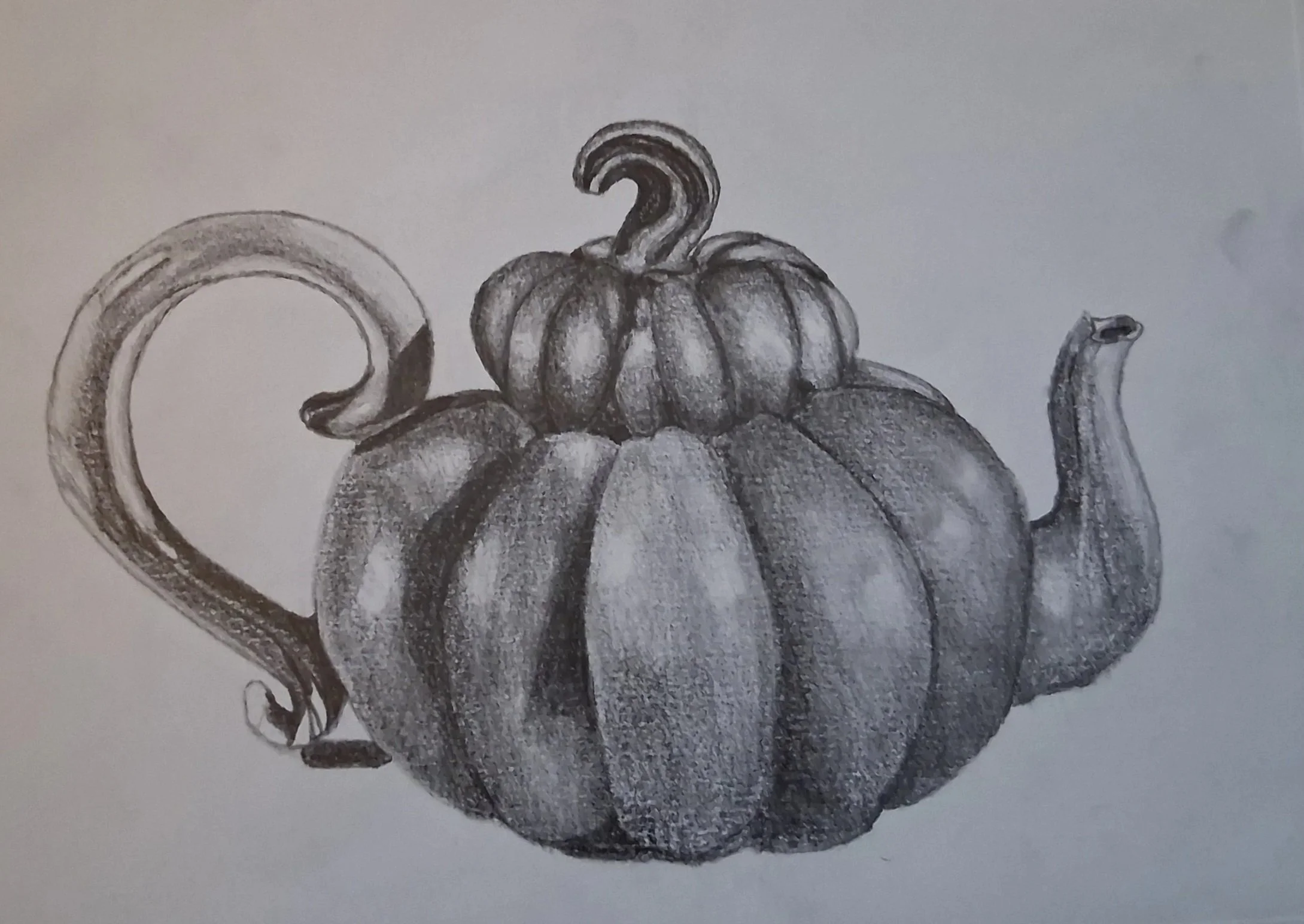
Georgia O'Keeffe-Inspired Pumpkin Teapot
Daniel Bangs · February 2024
Coloured Pencil On Paper · 18 hours
A4
Daniel Bangs · July 2023
Coloured Pencil On Paper
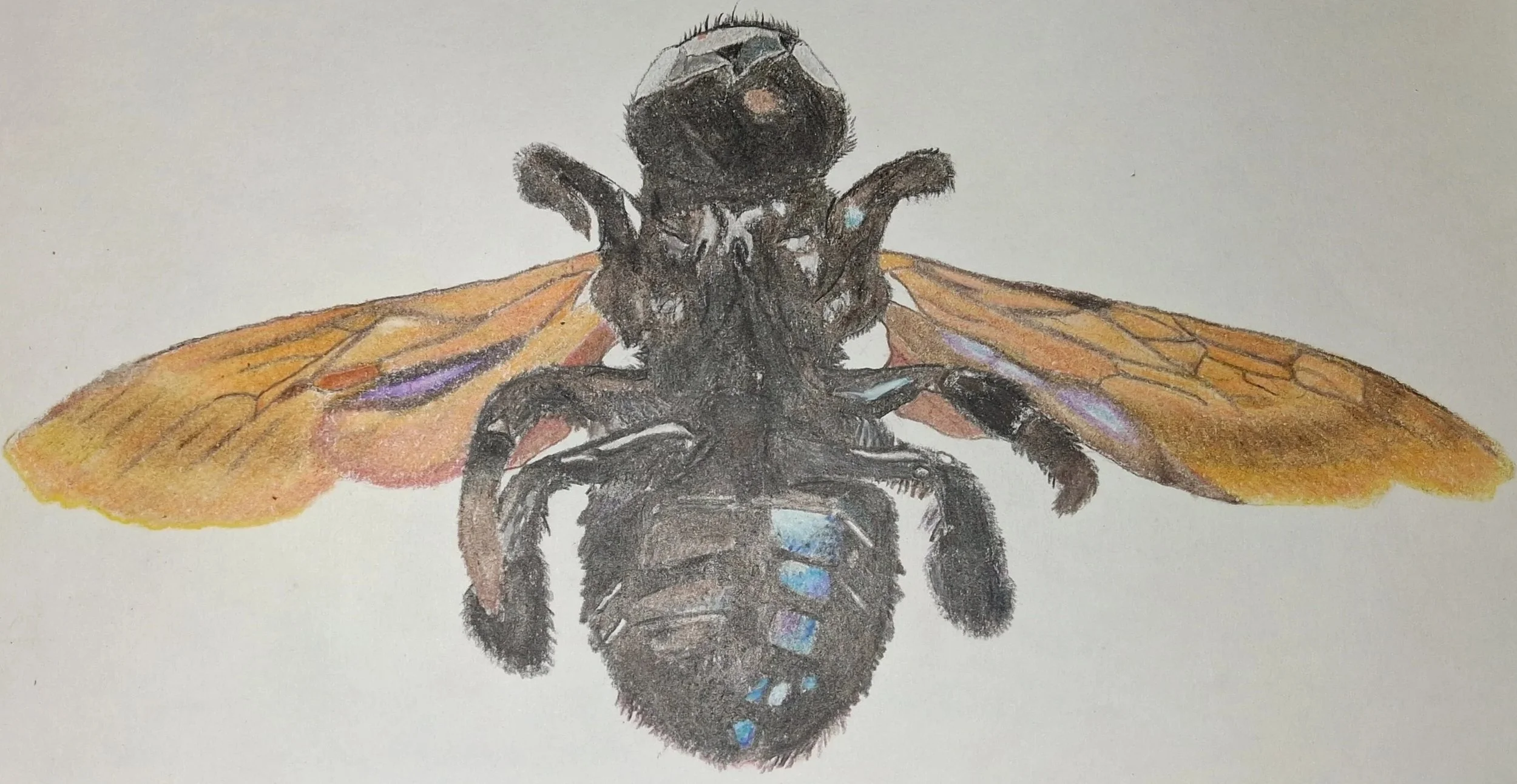
Beetle
Daniel Bangs · June 2023
Coloured Pencil On Paper · 12 hours
A5
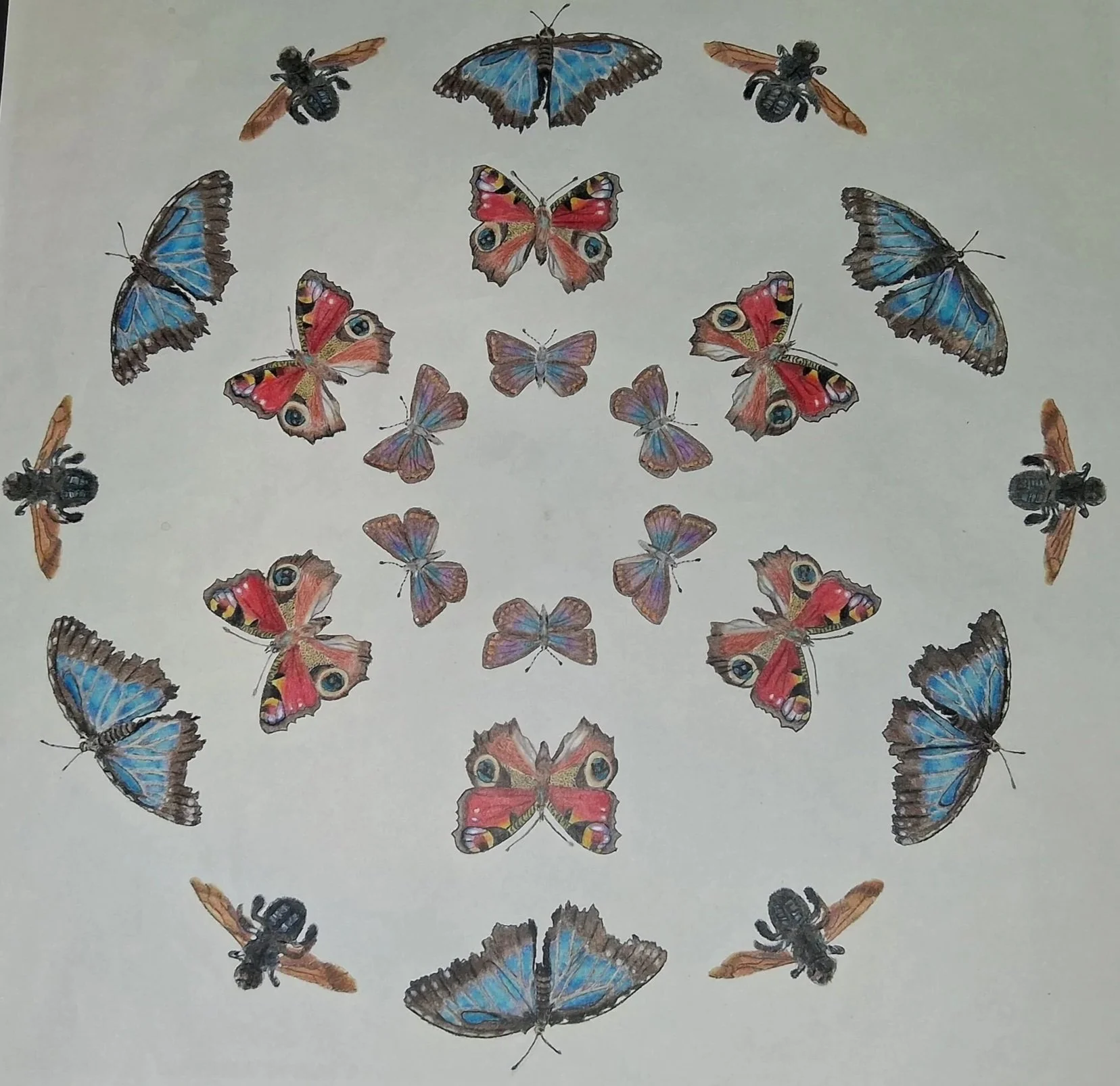
Butterfly Kaleidoscope
Daniel Bangs · February 2024
Coloured Pencil On Paper · 100 hours
A1
Butterfly Kaleidoscope was the final outcome of my Natural Structures coursework and the culmination of the techniques and ideas I had developed throughout the project. Created on an A1 sheet, the piece took approximately two months and more than 100 hours to complete.
The composition was designed around repetition and symmetry. Rather than completing individual butterflies across the whole piece, I worked systematically section by section and insect by insect, repeating each stage across the composition before moving on. This allowed me to keep corresponding sections as consistent as possible in their shape, colour, pattern and level of detail, while gradually building the larger kaleidoscopic arrangement.
The scale and complexity made this substantially more demanding than my earlier work. Maintaining consistency across such a large composition required careful planning and patience, particularly as small differences became increasingly noticeable as the repeated sections developed.
As the final piece of the project, Butterfly Kaleidoscope brought together the themes that had emerged throughout Natural Structures: symmetry, repetition, intricate natural forms and detailed observational drawing. It also represented the largest and most time-intensive artwork I produced during the project, turning the individual butterfly studies I had developed over the preceding work into a single resolved composition.
Boundaries, Borders & Edges
Boundaries, Borders & Edges was my final GCSE Art project, responding to the externally set theme through the landscapes, structures and machinery of warfare. I became particularly interested in the most literal manifestations of boundaries: trenches, fortifications and defensive environments designed to divide, contain and protect.
Research again extended well beyond the sketchbook. I visited three museums, including The Tank Museum and Imperial War Museums, building my own library of photographs of military vehicles, equipment and environments to work from. Tanks became a particularly useful subject for developing the highly controlled graphite technique that had begun to emerge during the final year of my course.
Where Natural Structures had pushed my use of colour, this project became increasingly concerned with graphite: perspective, mechanical complexity, surface texture and extremely fine detail. Individual drawings took upwards of 25–30 hours as I worked through rivets, armour plates, tracks, timber, earth and other materials individually.
The project ultimately moved from studies of individual objects and machinery towards the constructed landscape of the First World War trench — bringing together the technical skills I had developed throughout the course.
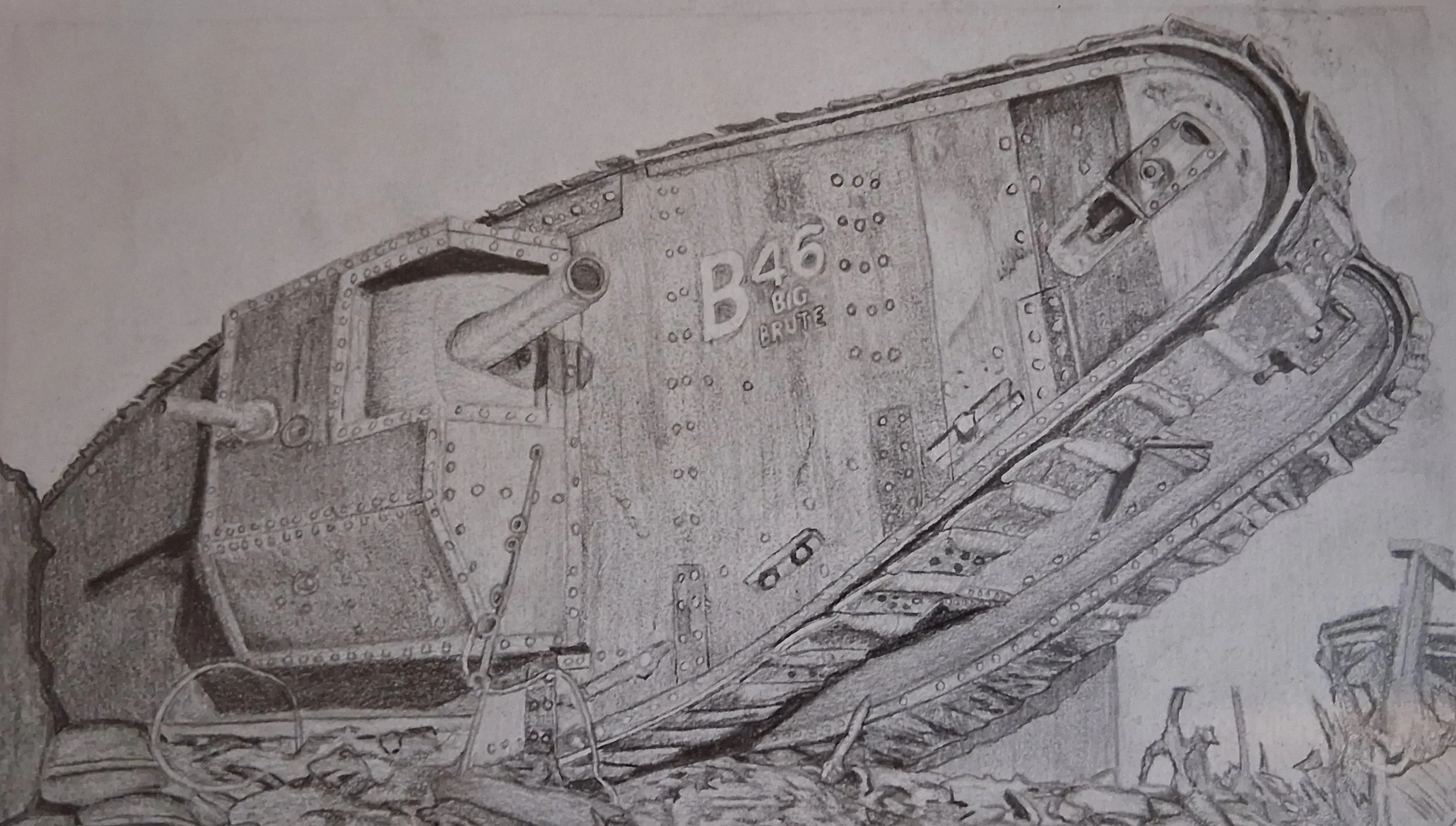
Daniel Bangs · February 2024
Graphite On Paper · 20 hours
A4
Trench with Soldier — Greyscale
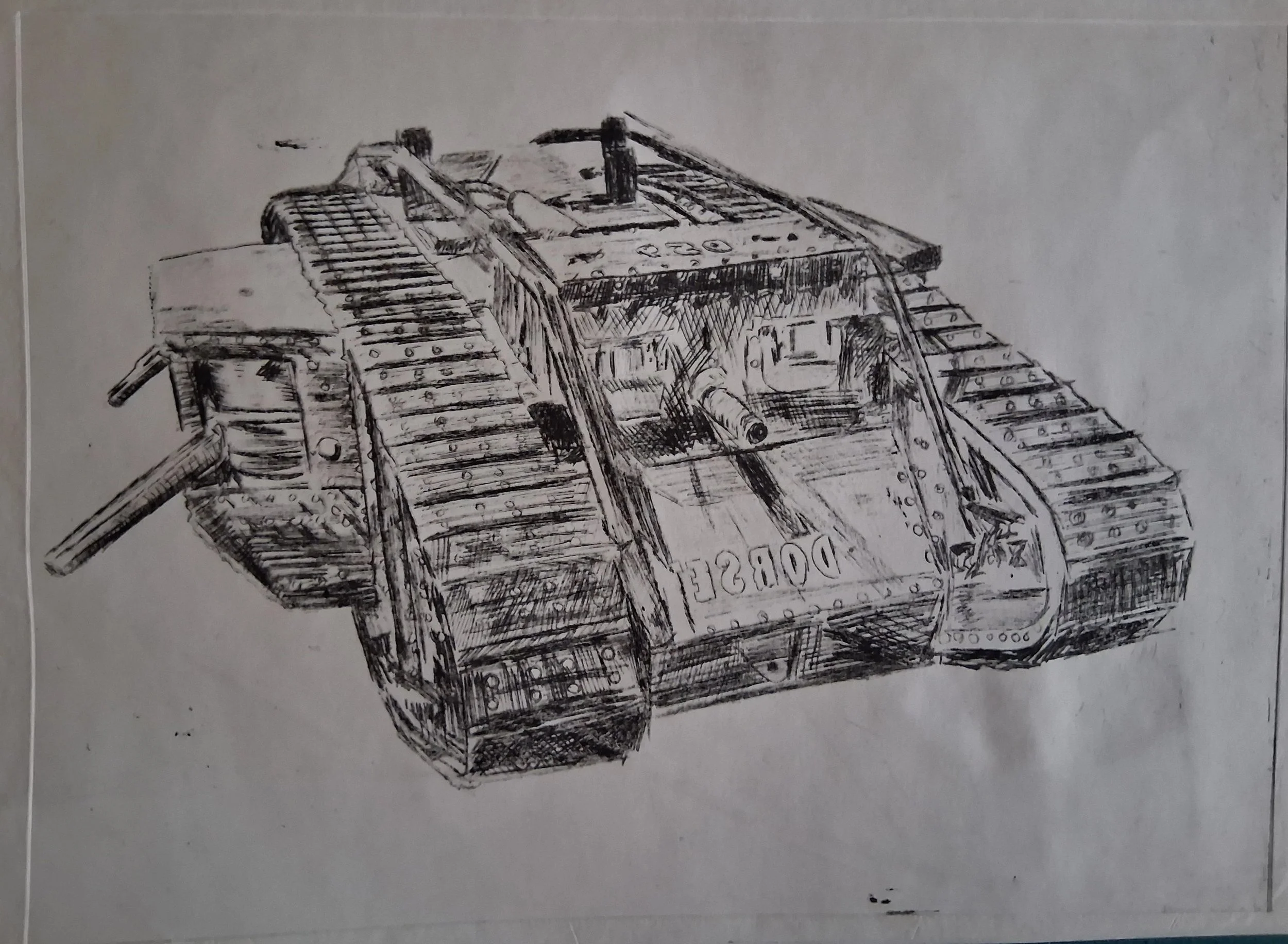
Daniel Bangs · February 2024
Graphite On Paper · 8 hours
A4
Trench with Soldier — Colour
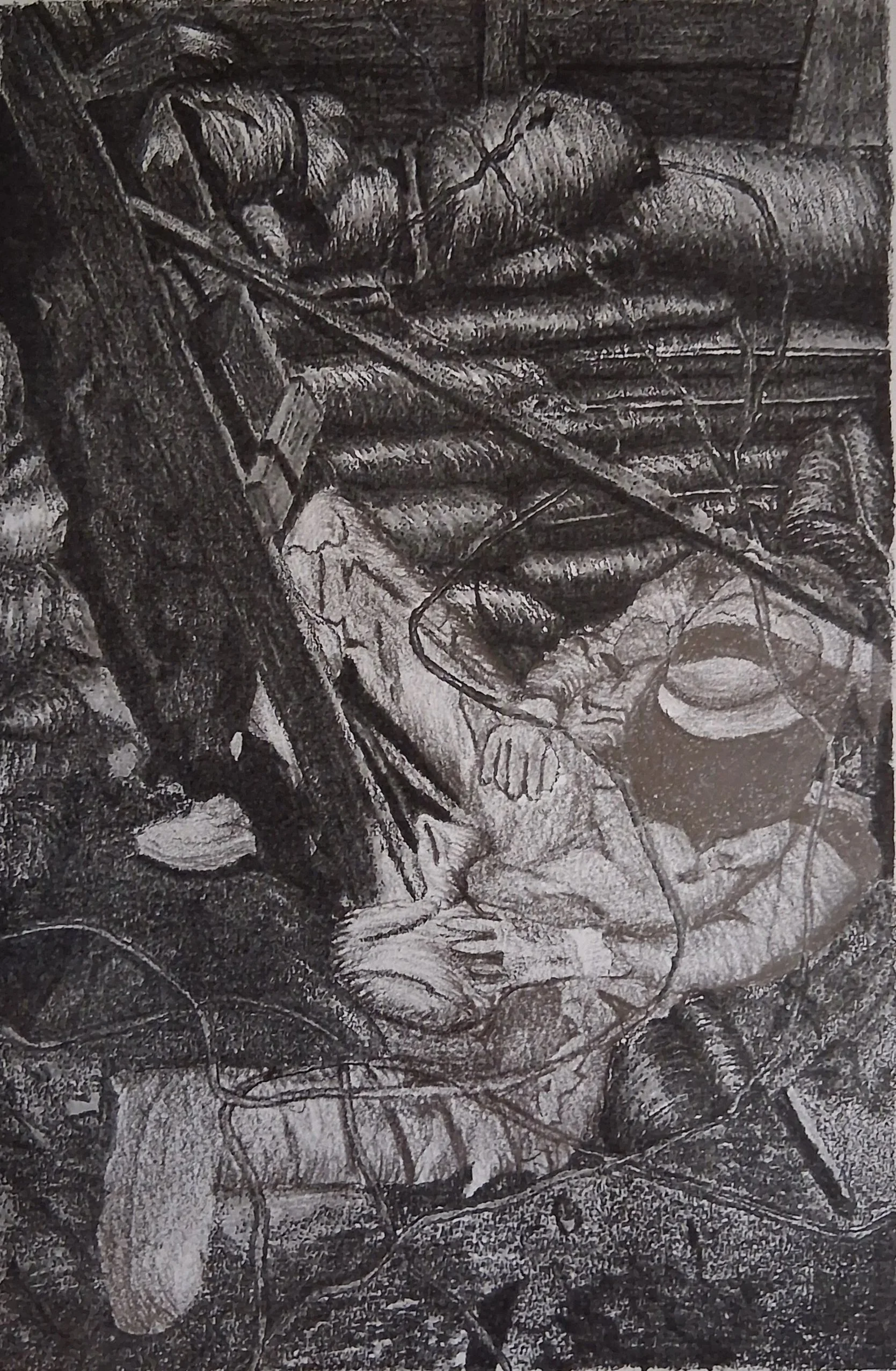
Daniel Bangs · April 2024
Graphite On Paper · 6 hours
A5
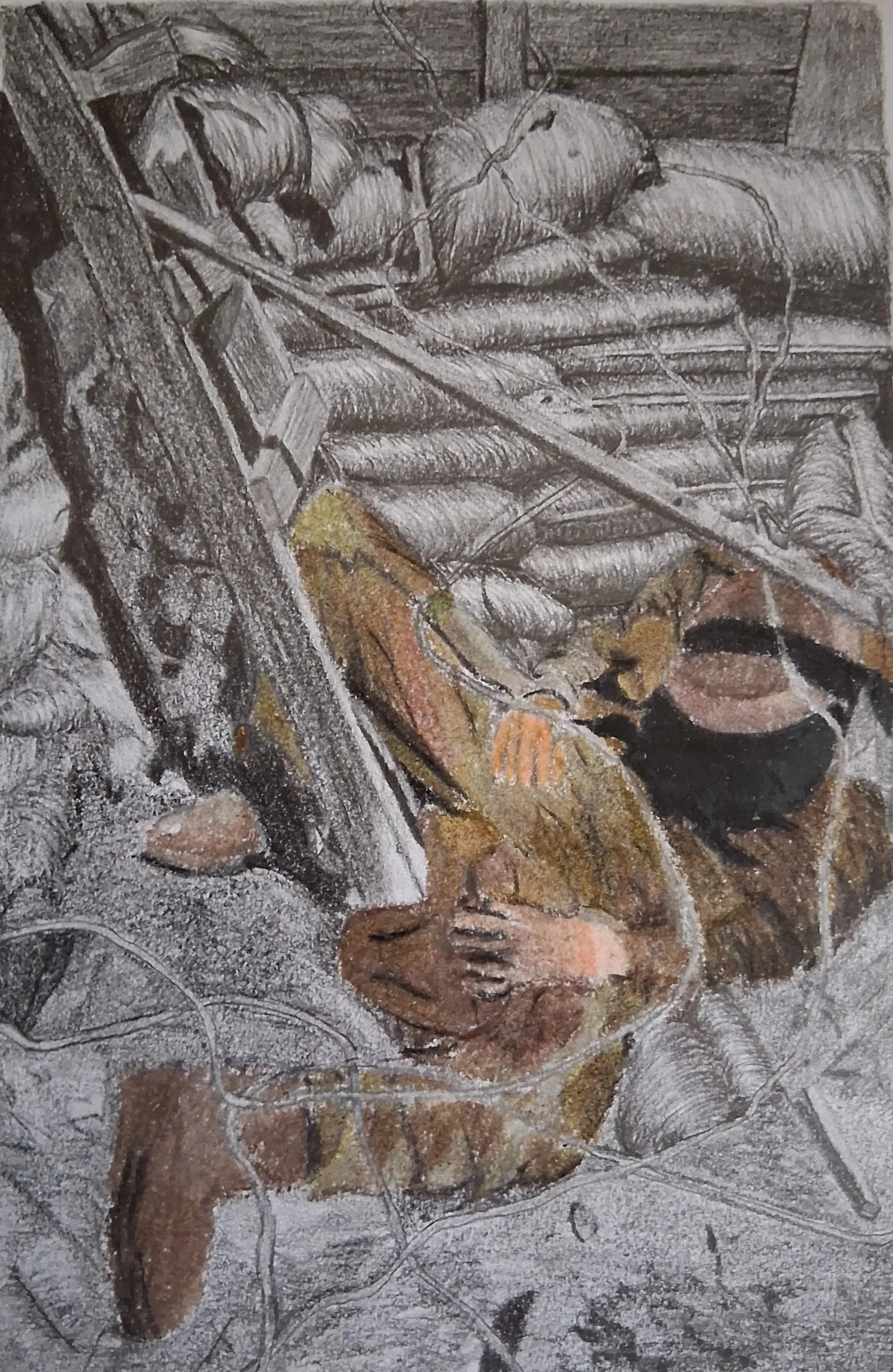
Daniel Bangs · April 2024
Graphite & Coloured Pencil On Paper · 16 hours
A5
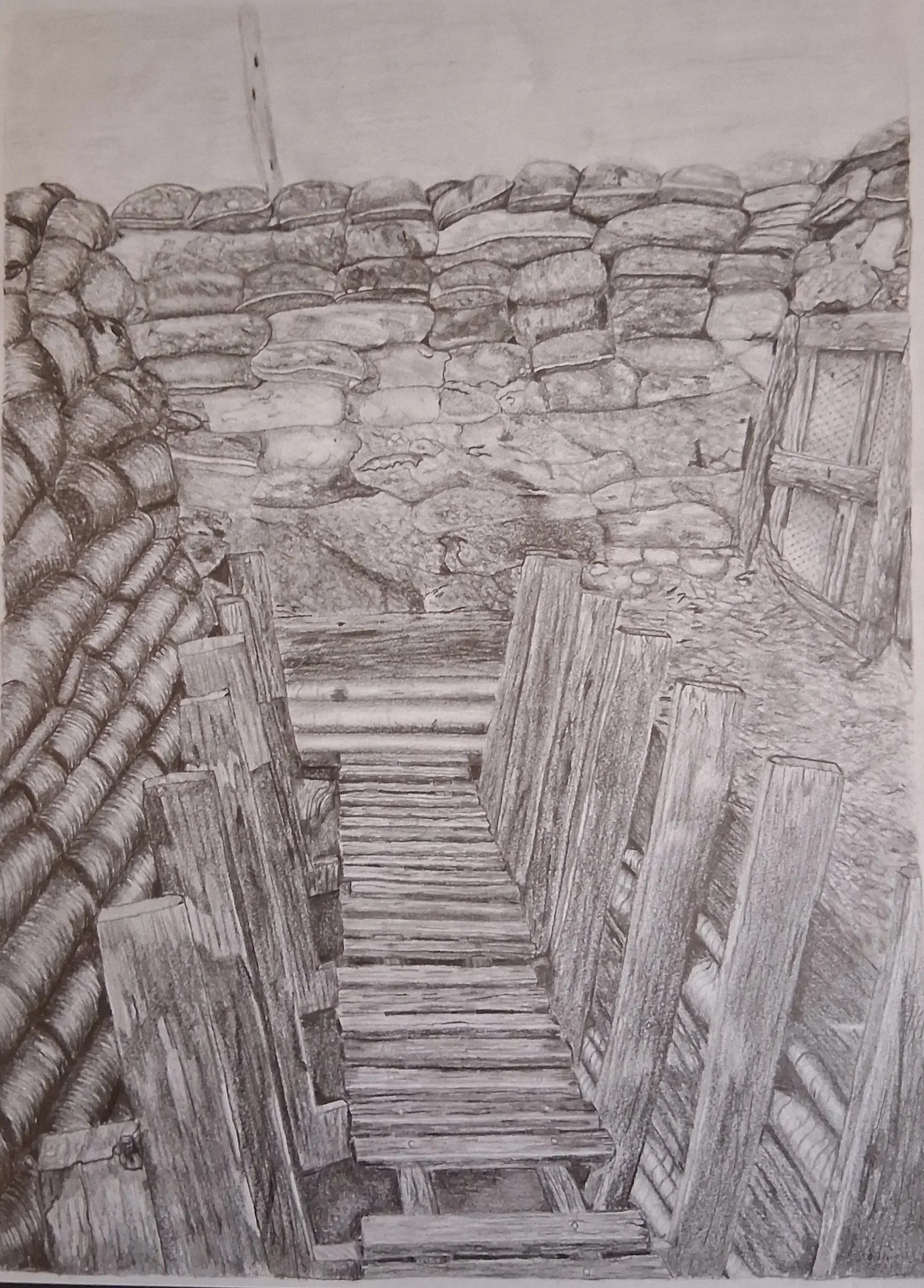
Ypres Trench — First Composition
Daniel Bangs · February 2024
Graphite on paper · 30 hours
A3
Created as the first piece of my Boundaries, Borders and Edges project, this A3 graphite composition marked the beginning of my exploration of the First World War and trench warfare. The drawing was based closely on one of my own photographs, taken during a battlefield trip to Ypres in October 2023, and was developed between January and February. The strong perspective of the trench, alongside its combination of sandbags, timber and earth, made it an interesting starting point for exploring depth, texture and tonal contrast.
The piece took approximately 30 hours to complete. One of the greatest challenges was reproducing the large number of sandbags while maintaining both their individual shapes and the broader areas of light and shadow across the scene. In response, I developed a more structured approach to hatching, using the direction of individual marks to describe the shape and curvature of each sandbag while varying their density to create shadow and depth across the wider composition.
This technique became an important part of my approach throughout the rest of the project. Rather than treating form and shading separately, the hatching allowed me to represent both simultaneously, and I continued to refine the method through the studies that followed. When I eventually returned to the Ypres trench for my final composition, I relied heavily on this technique to tackle the greater scale and complexity of the piece.
As the starting point for the project, the drawing also established much of the visual direction for the work that followed. I subsequently focused on other elements of First World War imagery, particularly tanks and the human figure, developing these independently before bringing them into the final composition. Returning to the same trench scene at the end of the project therefore allowed me to combine the original idea with the techniques and subjects I had explored in the intervening work.
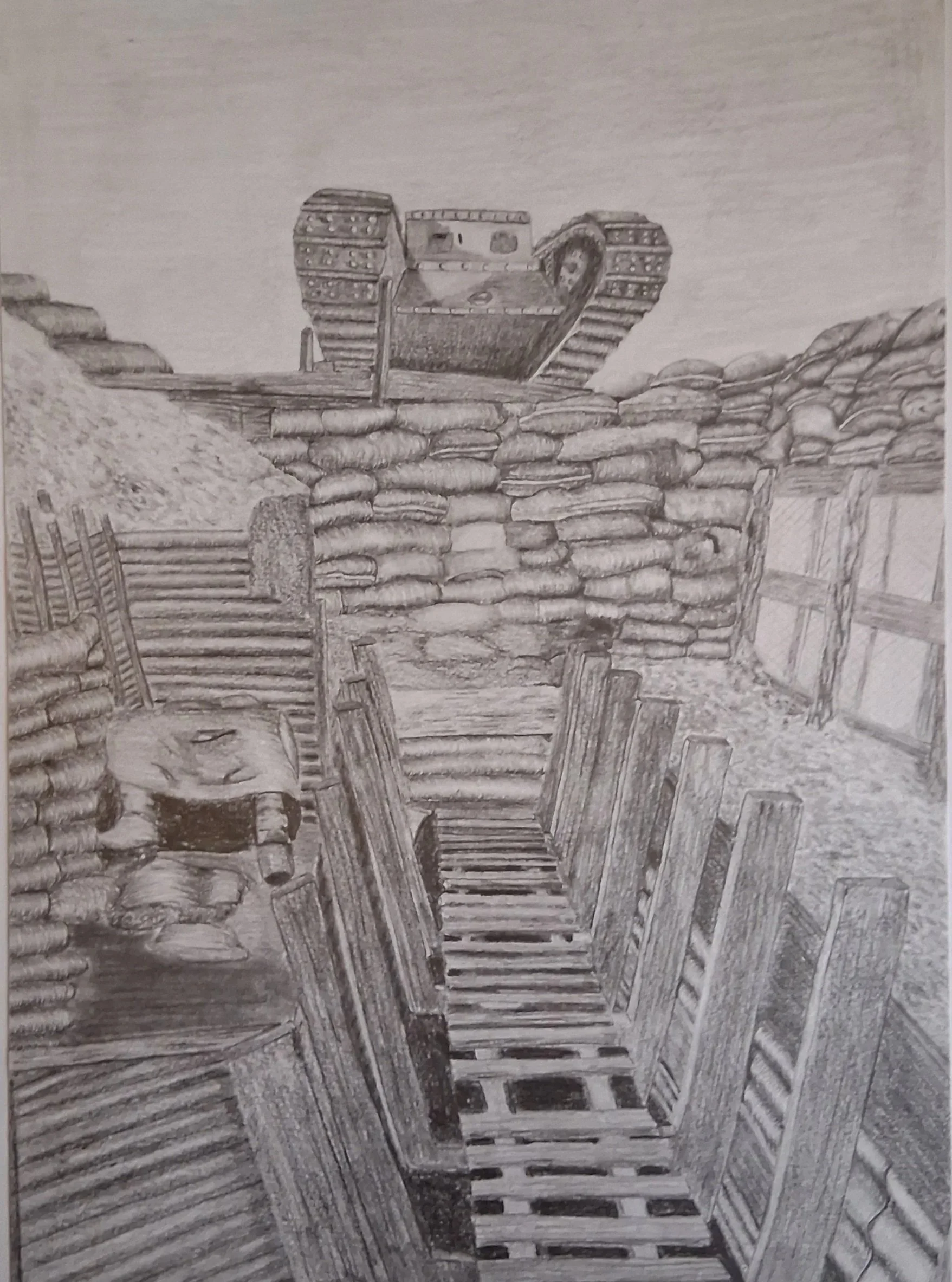
Ypres Trench — Final Composition
Daniel Bangs · April 2024
Graphite On Paper · 10 hours
A3
Created as the final outcome of my Boundaries, Borders and Edges project, this A3 graphite composition returned to the Ypres trench that had formed the starting point of the project. Rather than simply recreating my earlier drawing, I used the final piece to bring together the different areas I had explored in the intervening work, incorporating both a tank and a human figure into the trench environment while applying the techniques I had developed throughout the project.
The composition relied heavily on the structured hatching technique I had first developed while producing my original Ypres trench drawing. This was particularly important for the sandbags, where the direction and density of the graphite marks needed to communicate both their individual forms and the wider areas of light and shadow. By returning to a familiar composition, I was able to apply this technique with greater confidence while increasing the complexity of the scene through the additional subjects.
The piece was completed in 10 hours under timed examination conditions, which made it one of the most challenging pieces I produced during my GCSE Art course. Unlike much of my previous work, there was no opportunity to overrun or continue refining the drawing afterwards. I therefore had to manage the ten hours carefully, balancing the level of detail I wanted to achieve against the need to complete the entire A3 composition within a fixed deadline. This was particularly demanding given the amount of detailed graphite work involved.
Ypres Trench — Final Composition was also the final drawing I produced for GCSE Art, marking the culmination not only of Boundaries, Borders and Edges, but of several years of developing my drawing technique. Returning to the subject with which the project had begun allowed me to combine the trench environment, tanks and human figure that I had explored separately throughout the project into one final piece. In that sense, the composition provided a natural conclusion to both the project and my GCSE Art course.
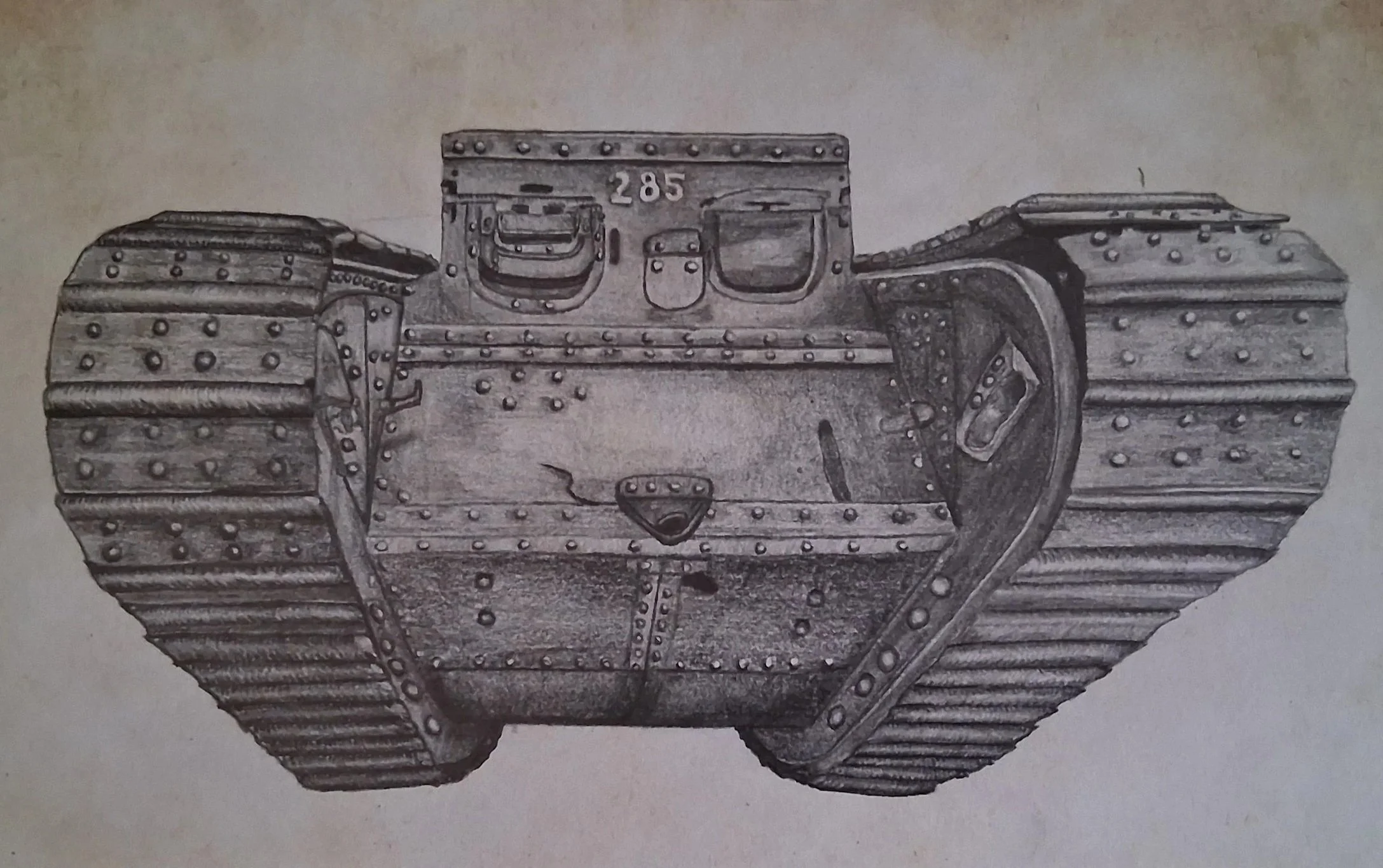
Mk I Tank — Front View
Daniel Bangs · March 2024
Graphite On Paper · 30 hours
A4
Created as part of my Boundaries, Borders and Edges project, this drawing studies the distinctive form of a First World War Mk I tank from the front. I focused particularly on proportion, perspective and the mechanical details of the vehicle, using careful tonal shading to create depth and distinguish the different surfaces and components.
The piece formed part of my early exploration of First World War imagery before I began developing the larger trench compositions later in the project. Drawing the tank in detail helped me understand its structure and visual character, elements that would later become part of the wider battlefield scenes used throughout my final work.
Tank — Drypoint Etching
Mk VII Tank — Side View
Looking Back
I didn't draw much for several years after completing this work. By the end of the course, something I had once enjoyed had become so intense that I needed some distance from it.
Looking back now, I'm glad I kept everything.
These pieces capture a period in which my ability developed extraordinarily quickly, but more importantly, they remind me how much patience I can have for something when I become completely invested in it. Some took a few hours, others took days, and one consumed more than 100 hours over several months.
After spending so long avoiding drawing, I'm beginning to feel differently about it again. I don't know exactly what I'll make next, but I'd quite like to find out.